| Sign In | Join Free | My benadorassociates.com |
|
| Sign In | Join Free | My benadorassociates.com |
|
| Categories | Zirconia Ceramic |
|---|---|
| Brand Name: | MH |
| Certification: | ISO9001 RoHS |
| Place of Origin: | CHINA |
| MOQ: | 200 pcs |
| Price: | USD 0.1-6 PCS |
| Payment Terms: | L/C, T/T, Western Union |
| Supply Ability: | 5000 PCS WEEK |
| Delivery Time: | 15-20DAYS |
| Packaging Details: | CARTON/WOODEN BOX |
| Material: | Zirconia ceramic |
| Color: | White or Black |
| Density: | 5.9g/cm³ |
| Working temperature: | 1400 ℃ |
| OEM,ODM: | Acceptable |
| Sample: | Available |
| Hardness: | 12.3 Gpa |
| Insulation breakdown Intensity: | 15 KT/mm |
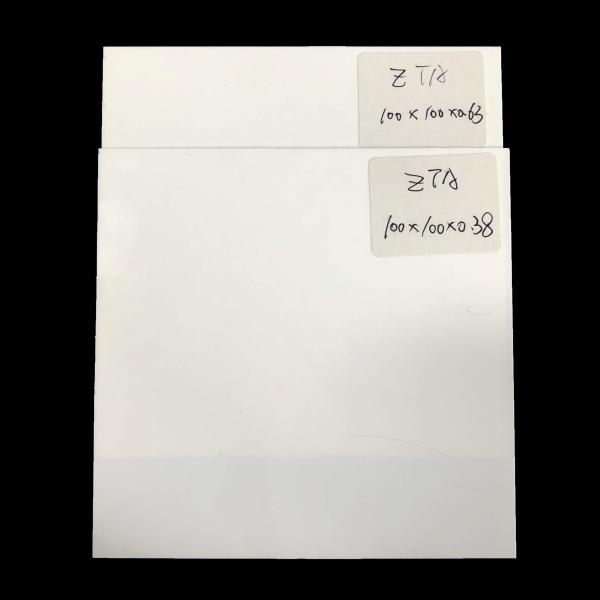
Polished YSZ ZTA Zirconia Ceramic substrate
Zirconia-toughened alumina ceramics, a particle size composition of
the main component of alumina in the preparation of
ceramiccylinder liners for drilling pumps, with an average particle
size of 60-70 wt% in the range of 0.8-1.0 μm and an
averageparticlesize of 30-40 wt% of 1.0 -2.8μm range of two types
of alumina. Add 15vol% of zirconia (containing 2 ~ 3mol% of
yttriumoxide), addappropriate amount of dispersant, mix by ball
milling, spray granulation, isostatic pressing, and fire in the
temperature range of1550 ~ 1620 C, it can be prepared for more than
2000 hours ceramic cylinder liner,and the formingand firing yield
is high, and the raw material and process costs are low. The
performance of zirconia-toughened alumina ceramics is better than
99 aluminaceramics, and the price is much lower than that of
zirconia ceramics.Many occasions where alumina ceramics are
incompetent show a better performance-price ratio than zirconia
ceramics.
Features & Advantages
1. High strength
2. High hardness
3. Wear resistance
4. Non-magnetic
5. Electrical insulation
6. Corrosion resistance in acids and alkalis
7. Modulus of elasticity similar to steel
8. Coefficient of thermal expansion similar to iron
| Properties | Unit | Steatite ceramic | 95% Al2O3 | 99% Al2O3 | Zirconia Ceramic |
| Density | g/cm³ | 2.8 | 3.6 | 3.8 | 5.6 |
| Flexural strength | Mpa | 145 | 300 | 300 | 354 |
| Max Working Temperature | ℃ | 1100 | 1400 | 1600 | 1400 |
| Sintering temperature | ℃ | 1350 | 1700 | 1750 | 1550 |
| Heat resistance | T(℃) | 200 | 220 | 200 | 350 |
| Hardness | Gpa | 5.7 | 7 | 10.7 | 12.3 |
| Elastic modulus | Gpa | 120 | 275 | 320 | 205 |
| Poissons ratio | - | 0.21 | 0.22 | 0.22 | 0.30 |
| Linear expansion coefficient | x 10-6/℃ | 7.9 | 7.1 | 7.8 | 9 |
| Insulation breakdown Intensity | KT/mm | 10 | 16 | 18 | 15 |
| Thermal conductivity | w/(m.k) | 2.5 | 20 | 25 | 2.5 |
| Specific Heat | *10-3J/(kg*K) | 0.75 | 0.78 | 0.78 | 0.4 |


|
 Polished Zirconia Ceramic Rod 5.9g/Cm3 Polished Zirconia Rod
3 Hole Ceramic Blade Zirconia Paper Cutting Blade Zirconia Ceramic Slitter
Pentagonal Zirconia Ceramic Utility Slitting Snap Off Razor Round Cutter Blade
Sharp Zirconia Disposable Surgical Blade Medical Surgical Blade ISO9001
High Precision Zirconia Ceramic Industrial Large Size Zirconia Ceramic Tube 1400C
YSZ Zro2 High Temperature Ceramic Tube Brazing Ceramic Tube For Furnace
High Toughness Smooth Zirconia Ceramic Yttria Stabilized Zro2 Ceramic Tube
High Strength Yttria Stabilized Zirconia Bead Wear Resistance Zirconia Grinding Ball
High Roughness Ceramic Box Cutter 5.9g/Cm3 Ceramic Blade Utility Knife
Hard Wearing White Zirconia Ceramic Substrate Irregular Shape Zirconia Ceramic Sheet
Polished Zirconia Ceramic Rod 5.9g/Cm3 Polished Zirconia Rod
3 Hole Ceramic Blade Zirconia Paper Cutting Blade Zirconia Ceramic Slitter
Pentagonal Zirconia Ceramic Utility Slitting Snap Off Razor Round Cutter Blade
Sharp Zirconia Disposable Surgical Blade Medical Surgical Blade ISO9001
High Precision Zirconia Ceramic Industrial Large Size Zirconia Ceramic Tube 1400C
YSZ Zro2 High Temperature Ceramic Tube Brazing Ceramic Tube For Furnace
High Toughness Smooth Zirconia Ceramic Yttria Stabilized Zro2 Ceramic Tube
High Strength Yttria Stabilized Zirconia Bead Wear Resistance Zirconia Grinding Ball
High Roughness Ceramic Box Cutter 5.9g/Cm3 Ceramic Blade Utility Knife
Hard Wearing White Zirconia Ceramic Substrate Irregular Shape Zirconia Ceramic Sheet

