| Sign In | Join Free | My benadorassociates.com |
|
| Sign In | Join Free | My benadorassociates.com |
|
| Categories | Backhoe Loader Machine |
|---|---|
| Brand Name: | HARVEST |
| Model Number: | SAM388H |
| Certification: | CE/ISO9001 |
| Place of Origin: | China |
| MOQ: | 1 unit |
| Price: | US$ 32,800 |
| Payment Terms: | T/T |
| Supply Ability: | 1000 units per month |
| Delivery Time: | 15-20 working days |
| Packaging Details: | nude |
| Rated Load: | 2.5ton |
| Backhoe Capacity: | 0.3m3 |
| Bucket Capacity: | 1.2m3 |
| Outrigger: | H-shaped outriggers |
| Axle: | Feicheng axle |
| Tire Size: | 16.9-28 |
| Operating Weight: | 10.5ton |
| Engine: | Cummins |
| Company Info. |
| Henan Harvest Machinery & Truck Co., Ltd |
| Verified Supplier |
| View Contact Details |
| Product List |
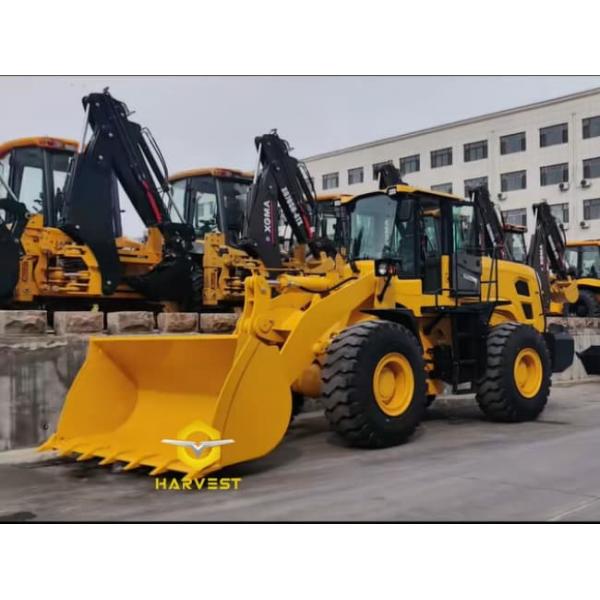
The basic concepts and structure of a backhoe loader
Definition: A backhoe loader organically combines the digging function of a
hydraulic excavator and the loading function of a loader, achieving
the effect of one machine with two functions, so it is commonly
known as a "backhoe loader".
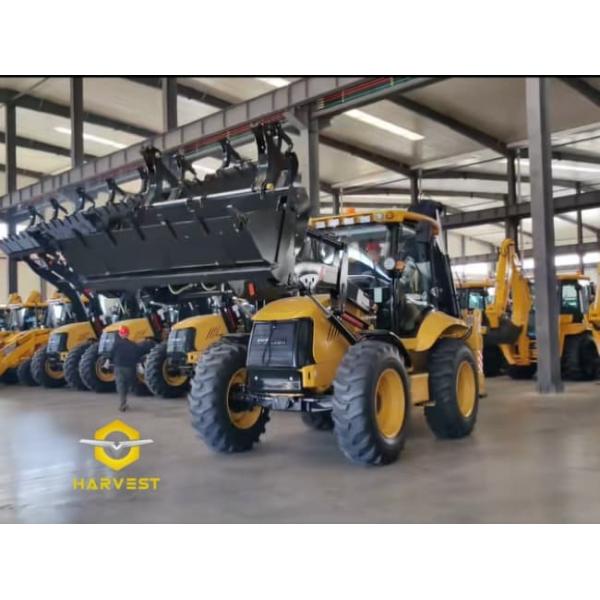
Appearance Structure: Generally, at one end of the backhoe loader is the loader's
bucket, which is used for shoveling and transporting materials. At
the other end is the excavator's working device, including the
boom, stick, and bucket, which can be used for operations such as
digging and demolition.
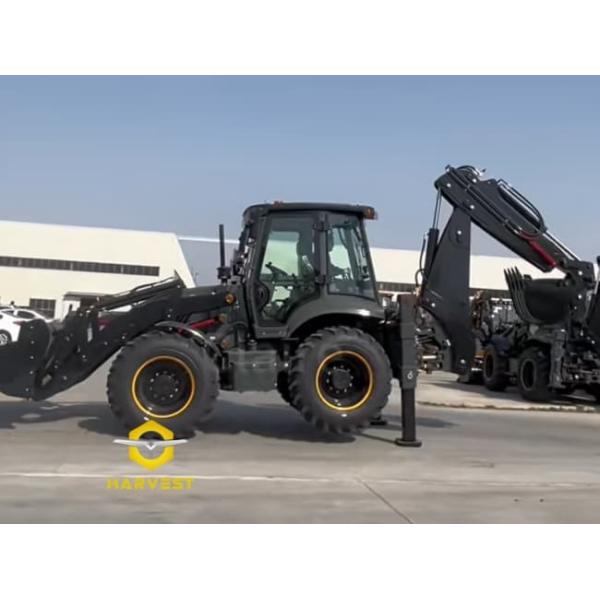
Main features of a backhoe loader:
1.The use of high-reliability hydraulic torque converter and Gearbox to provide super power, aggravated the smooth and high reliability of the dedicated engineering bridge walking.
2.Combine the excavator and the loader into one, and one machine can do more. Fully equipped with all the functions of small excavators and loaders, it is more suitable for operating in a narrow space, convenient and flexible, and working efficiency is increased by more than 30 %.
3.Humanized design of rotating vibration absorber seat, fully tempered and molded glass cab , wider vision, more comfortable driving.
4.Excavate the lateral sliding mechanism device to make the excavation operation more extensive and more efficient.
5.The design of the front flip cover greatly improves the maintenance of the entire machine.
6.A variety of accessories can be selected to complete a variety of construction operations. For use in municipal administration, construction, water Conservancy, highways, tap water, power supply, gardens and other departments, can be engaged in agricultural construction, pipeline laying, cable laying, landscaping and other operations.
SAM388H Backhoe Loader Cummins Engine 4WD Hot Sale in Near Nigeria
| Overall Dimension | ||||||
| 1 | Length(with bucket on ground) | 6450±80mm | ||||
| 2 | Overall width(at stabilizer ) | 2490±10mm | ||||
| 3 | Load Bucket width | 2490±10mm | ||||
| 4 | Height(To the top of the cab) | 3120±10mm | ||||
| 5 | Height(To the top of the digging pole) | 3940 ±20mm | ||||
| 6 | Wheel base | 2335±10 mm | ||||
| 7 | Back wheel Tread | 2139 ±10mm | ||||
| Main Loading Technical Specification | ||||||
| 1 | Rated load | 2500KG | ||||
| 2 | Operating weight | 9120kg | ||||
| 3 | Rated bucket capacity | 1.2m³ | ||||
| 4 | Max. dump clearance | 3050±50 mm | ||||
| 5 | Dump reach | 870±20 mm | ||||
| 6 | Outside of bucket | 6420±100mm | ||||
| Main Digging Technical Specification | ||||||
| 1 | Rated digging bucket capacity | 0.3m³ | ||||
| 2 | Max. digging depth | 3820±20 mm | ||||
| 3 | Max. digging radius | 5345±20mm | ||||
| 4 | Max. dumping height | 3740±20mm | ||||
| 5 | Max. digging force | kgf | ||||
| 6 | Max. Digging Height | 5470 ±20mm | ||||
| 7 | Lifting force at maximum digging radius | 1220kg | ||||
| 8 | Maximum digging depth (telescopic arm) | 4970±20 mm | ||||
| 9 | Maximum loading height (telescopic arm) | 4983±20mm | ||||
| 10 | Maximum digging height (telescopic arm) | 6680±20mm | ||||
| Diesel engine | ||||||
| 1 | Model | YC4A105Z-T20 | ||||
| 2 | Type | Water cooled | ||||
| 3 | Rated output | 75 (kW) | ||||
| 4 | Total exhaust of cylinder | 4.8(L) | ||||
| 5 | Rated speed | 2200(r/min) | ||||
| 6 | Max. Torque | 400(N.M) | ||||
| Transmission System | ||||||
| 1 | Torque Converter | Model | 315 | |||
| Cooling type | Pressure oil circulating | |||||
| 2 | Transmission case | Model | 15 | |||
| Type | Synchromesh mechanical shift | |||||
| 3 | Axle and Tire | Model | WZL100 | |||
| 4 | Gear shift position | 4 F, 4 R | ||||
| 5 | (F/R)km/h | F1,5km/h;F2,10km/h; F3,18km/h;F4,32km/h; R1,5km/h;R2,10km/h; R3,18km/h;R4,32km/h; | ||||
| 6 | Size of tire | 16.9-28 | ||||
| The hydraulic system | ||||||
| 1 | Working pump discharge | 63ml/r | ||||
| 2 | Working pump pressure | 20Mpa | ||||
| 3 | Type of steering gear | BZZ-500 | ||||
| Excavating equipment (crushing hammer) | ||||||
| 1 | Drill rod diameter (mm) | 68-70 | ||||
| 2 | Pressure of work ( Mpa) | 11-14 | ||||
| 3 | The impact frequency | 500-900 | ||||
| 4 | Flow range ( L/min) | 25-45 | ||||
| 5 | The kinetic energy ( KN) | 49 | ||||
| Oil Capacity | ||||||
| 1 | The hydraulic oil tank | 125 L | ||||
| 2 | Diesel fuel tank | 125 L | ||||
Working Characteristics:
Multi - functional in One Machine: Besides the basic digging and loading functions, attachments such
as a jib crane, forklift forks, sweeper, breaker, vibrating rammer,
etc. can be installed to complete a variety of different operation
tasks.
High Flexibility: It has a compact size and is equipped with a 4 - speed or 5 - speed
hydraulic transmission. Its maximum speed can reach 40km/h,
enabling rapid mobility. It can move around on various construction
sites and even travel on the road, making it suitable for operating
in small spaces.
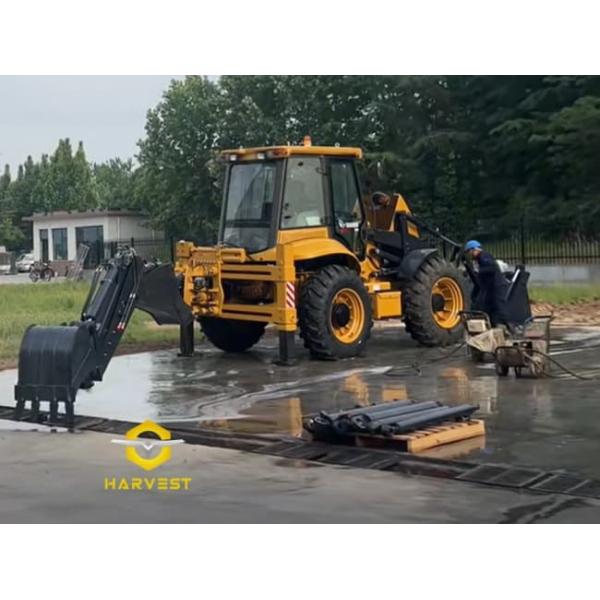
Application Fields:
Municipal Engineering: It is often used in urban road construction and maintenance, cable
laying, pipeline gas construction, water pipeline laying, etc. It
can perform tasks such as digging ditches, laying pipelines, and
breaking road surfaces.
Construction Projects: At construction sites, it is used for material handling, site
leveling, foundation excavation, etc. It can also be applied to
rural residential construction, quarrying, and construction
projects carried out by various small construction teams.
Landscaping: It can be used for tree transplanting, digging tree pits, loading
and unloading landscaping materials, etc.
The Great Significance of Nigeria's Choice of Backhoe Loaders as Construction Machinery:

|
 2.5 Ton Bucket Dumping Height 2742mm 4WD SAM388 Wheeled Backhoe Loader
4WD 102HP Engine SAM388 2.5ton Backhoe Loader Machine 0.3m3 Backhoe for Kenya
SAM388 4WD 102HP 75kW Engine 0.3m3 Bucket Backhoe Wheel Loader
Bucket Digging Depth 4082mm MR30-25 4x4 Mini Excavator Backhoe Loader
Front Bucket 1m3 75kW Cummins Engine 0.3m3 WZ30-25 Backhoe Loader
Bucket Digging Depth 52mm MR30-25 Backhoe Loader Machine With H Outrigger
2.5 Tons Backhoe Loader 388 with Yuchai Engine for Sale in Africa
High Quality Backhoe Loader 388, 388II, 388H from China Factory
388H 4 Wheels Steering 2.5 Ton Backhoe Loader with 6 in 1 Bucket
2.5 Ton 4x4 Backhoe Loader 388 with Cummins Engine 1m3 Bucket For Sale
2.5 Ton Bucket Dumping Height 2742mm 4WD SAM388 Wheeled Backhoe Loader
4WD 102HP Engine SAM388 2.5ton Backhoe Loader Machine 0.3m3 Backhoe for Kenya
SAM388 4WD 102HP 75kW Engine 0.3m3 Bucket Backhoe Wheel Loader
Bucket Digging Depth 4082mm MR30-25 4x4 Mini Excavator Backhoe Loader
Front Bucket 1m3 75kW Cummins Engine 0.3m3 WZ30-25 Backhoe Loader
Bucket Digging Depth 52mm MR30-25 Backhoe Loader Machine With H Outrigger
2.5 Tons Backhoe Loader 388 with Yuchai Engine for Sale in Africa
High Quality Backhoe Loader 388, 388II, 388H from China Factory
388H 4 Wheels Steering 2.5 Ton Backhoe Loader with 6 in 1 Bucket
2.5 Ton 4x4 Backhoe Loader 388 with Cummins Engine 1m3 Bucket For Sale