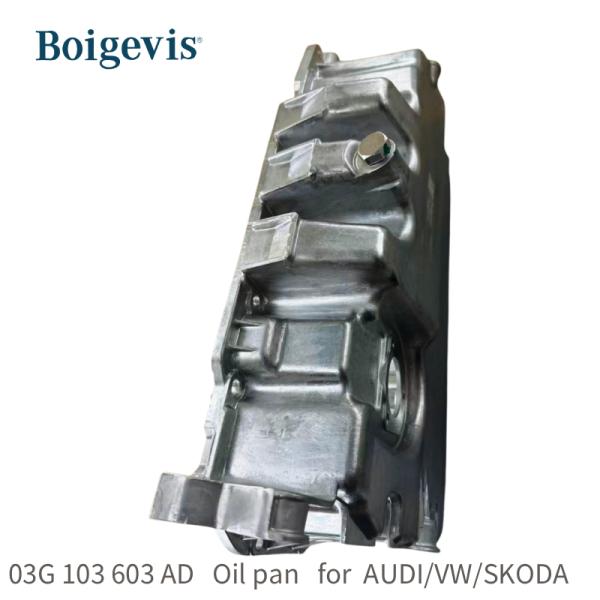
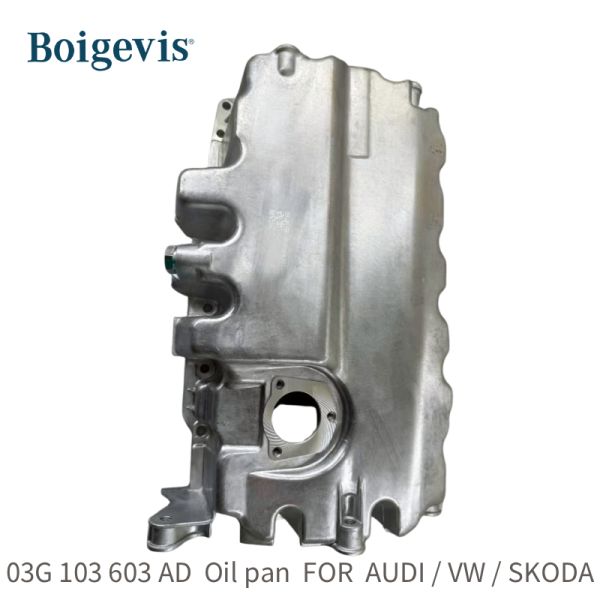
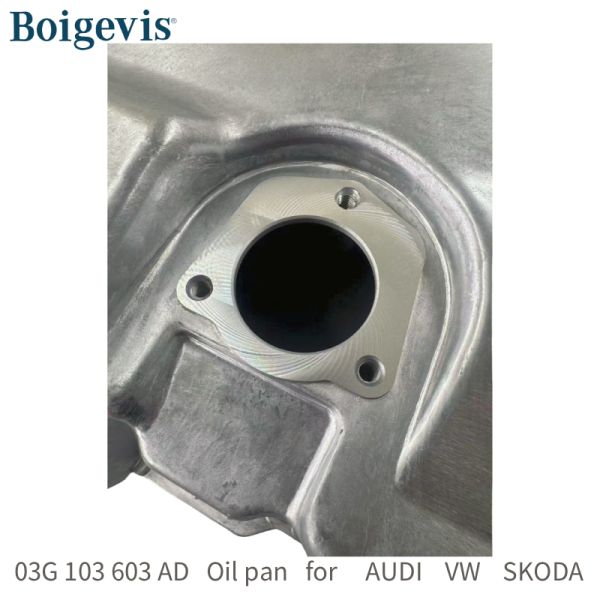
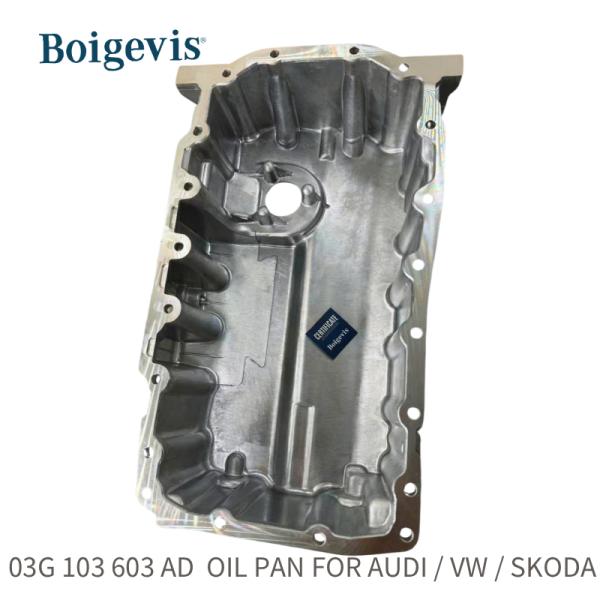
03G 103 603 AD Oil Pan Fits Audi A3 Volkswagen Golf Skoda And Other
Models
| OEM | 03G 103 603 AD |
| Point of Origin | Guangdong, China |
| Type | Oil Pan Kit |
| Fitment Type | Direct Replacement |
I. Precise Applicable Models & Technical Parameters
Part Number Interpretation
03G: Exclusive prefix for diesel engine parts of the Volkswagen Group,
mainly applicable to the group’s EA189 series diesel engines. It is
a key identifier to distinguish between petrol and diesel parts.
AD: Represents the part version suffix, corresponding to high-strength
stamped steel material (some batches use lightweight aluminum
alloy). It is specifically designed for the high-torque output
characteristics of diesel engines to enhance impact resistance and
vibration resistance.
Core Applicable Scope
1. Audi
Model: Audi A3, corresponding to chassis code 8P, with production years
covering 2005–2013
Engine Models: Compatible with 2.0 TDI engines (specific models: CBAB, CRCA)
Displacement & Power: 2.0L displacement, maximum power 140–170 PS, maximum torque
320–350 N・m, including front-wheel drive and quattro all-wheel
drive versions.
2. Volkswagen
Volkswagen Golf V: Chassis code 1K, production years 2003–2008, compatible with 2.0
TDI engines (models: BKD, BMM), 2.0L displacement, maximum power
140 PS, maximum torque 320 N・m, including Golf Variant (estate
version);
Volkswagen Golf VI: Chassis code 5K, production years 2008–2014, compatible with 2.0
TDI engines (models: CRHC, CRHD), 2.0L displacement, maximum power
140–170 PS, maximum torque 320–350 N・m, also covering estate
versions.
3. Skoda
Skoda Octavia II: Chassis code 1Z, production years 2004–2012, compatible with 2.0
TDI engines (models: BMM, CBAB), 2.0L displacement, maximum power
140 PS, maximum torque 320 N・m, including Octavia Combi (estate
version).
4. Seat
Seat León II: Chassis code 1P, production years 2005–2012, compatible with 2.0
TDI engines (models: BKD, CBAB), 2.0L displacement, maximum power
140 PS, maximum torque 320 N・m.
Excluded Applicable Models
Petrol engine models: Such as Volkswagen 1.4 TSI, 1.8 TSI, Audi 2.0 TFSI, etc. The oil
pan interface size and oil circuit layout of these models are
completely different from those of diesel versions. Forced
installation will cause engine oil leakage or lubrication failure;
Hybrid/electric models: Such as Audi A3 e-tron, Volkswagen Golf GTE. Their cooling system
layouts are significantly different from those of traditional
diesel vehicles, so there is no need to install this oil pan;
Rear-wheel drive/longitudinally mounted engine models: Such as Audi A4 B8, Volkswagen Passat B7. These models adopt a
longitudinally mounted engine layout, and the shape and fixing
points of the oil pan are incompatible with models on the PQ35/PQ46
platform with transversely mounted engines.
Special Note
Some early models produced between 2003–2005 (e.g., Volkswagen Golf
V) may be equipped with 1.9 TDI engines (models ALH, PD series).
For such models, additional precise verification is required
through the 10th digit of the vehicle VIN (year code) and engine
model (e.g., ALH, BKD) to avoid confusion with parts for 2.0 TDI
models.
II. Core Functions & Technical Characteristics
1. Diesel Engine-Specific Structural Design
High-strength impact-resistant material: Aimed at the high-torque output of diesel engines (the peak torque
of 2.0 TDI can reach 350 N・m), it is made of double-layer stamped
steel or lightweight aluminum alloy with a material thickness of
1.8–2.5 mm. It can withstand engine vibration and chassis impact
for a long time to prevent oil pan deformation;
Deep oil sump capacity design: The oil sump capacity is 15–20% larger than that of petrol engine
oil pans on the same platform, approximately 5.5–6.5 L. This
ensures that the oil pump can always suck in sufficient engine oil
when the vehicle is subject to off-road bumps or sudden
acceleration, preventing lubrication failure caused by insufficient
engine oil supply (especially suitable for the high lubrication
needs of turbochargers).
2. Thermal Management & Noise Reduction Optimization
Integrated engine oil cooling channel: Some batches of oil pans have built-in independent cooling
pipelines, which can work in coordination with the engine coolant
system to reduce the engine oil temperature by 8–12℃. This
effectively alleviates the aging problem of turbochargers caused by
high temperatures and extends the turbocharger overhaul cycle by
20%;
Honeycomb-shaped energy-absorbing inner wall: A honeycomb structure is formed on the inner wall of the oil pan
through a special stamping process, which can absorb vibration
waves generated during engine operation, reduce the transmission of
vibration to the vehicle body, and lower the in-vehicle noise by
2–3 dB(A) (the effect is particularly obvious at idle speed and
low-speed driving).
3. Filtration & Sealing Protection System
Magnetic oil drain plug: A standard M14×1.5 specification magnetic oil drain plug (original
equipment (OE) part number: N 902 247 01) is provided. The strong
magnet at the head of the plug can absorb metal debris (such as
iron filings generated by engine wear) in the engine oil, with a
filtration efficiency of 92%, reducing the risk of clogging of the
oil pump and oil passages by debris;
Temperature-resistant sealing assembly: When installing, it is necessary to match the original
rubber-metal composite sealing ring (part number: 03G 103 601). The
sealing ring is made of fluorosilicone rubber material with a
temperature resistance range covering -40℃ to 150℃. This ensures no
engine oil leakage from the oil pan within 100,000 kilometers under
extreme temperature difference environments.
III. Key Roles in the Vehicle
1. Core Hub of the Lubrication System
Oil storage and supply guarantee: As the main storage container for engine lubricating oil, the oil
pan stably delivers engine oil to the oil pump through the built-in
oil strainer, and then the oil pump distributes the oil to key
friction pairs such as the crankshaft, connecting rods, and
turbocharger. It ensures that the engine oil pressure reaches 2.5
bar within 2 seconds during cold start, meeting the immediate
lubrication needs of the engine;
Impurity sedimentation and purification: The bottom of the oil pan adopts a 12° inclined design, which
promotes the sedimentation of metal debris and impurities in the
engine oil near the oil drain plug. Combined with the adsorption
effect of the magnetic oil drain plug, it reduces the wear of
internal engine parts caused by impurities circulating with the
engine oil.
2. Protective Barrier for Power Transmission
Torsion resistance support and structural reinforcement: It is rigidly connected to the engine block through 6–8
high-strength bolts, which can withstand the combustion pressure of
diesel engines during operation (the peak pressure can reach 180
bar), reduce the displacement of the engine during operation, and
lower power transmission loss;
Corrosion protection and durability guarantee: The surface of the oil pan undergoes double treatment of
electrophoretic coating (coating thickness 20–25 μm) and
galvanizing, which can resist corrosion from road deicing agents
and ethylene glycol coolant. Its service life can reach more than
15 years in humid or salty environments.
3. Adaptability to Complex Working Conditions
Adaptability to off-road scenarios: The minimum height of the oil pan from the ground is designed to
be 150–180 mm. Combined with the edge reinforcement rib structure,
it can withstand a lateral impact of 100 N・m (such as bumps when
passing over rough roads) to prevent oil pan damage;
Stability in high-load scenarios: During high-load working conditions such as track driving and
high-speed cruising, the deep oil sump design can prevent "oil
starvation" caused by severe sloshing of engine oil, ensuring
continuous lubrication of components such as turbochargers and
crankshafts, and avoiding overheating damage caused by insufficient
lubrication.
IV. Verification & Maintenance Recommendations
1. Precise Matching Steps
• First, check the vehicle VIN, enter the chassis number in the
Volkswagen Audi ETKA electronic parts catalog to obtain the oil pan
assembly diagram of the corresponding model, and verify whether the
part number is 03G 103 603 AD;
• Second, check the engine model. For example, for Audi A3 8P
models, it is necessary to confirm that the specific model of the
2.0 TDI engine is CBAB (2009–2013 models) or CRCA (2011–2013
models) to avoid mistakenly installing the oil pan of the early BKD
engine.
2. Replacement & Maintenance Key Points
Bolt torque control: When installing, a torque wrench must be used to tighten the oil
pan bolts in phases according to the standard of "25 N・m
pre-tightening + 90° angle turn". This avoids oil pan deformation
caused by excessive torque or leakage caused by insufficient
torque;
Synchronous replacement of components: When replacing the oil pan, it is recommended to simultaneously
replace the engine oil filter (OE part number: 03G 115 561 B) and
the oil cooler gasket (part number: 03G 121 115), and thoroughly
clean the residual impurities inside the oil pan;
Part selection principle: Priority should be given to original parts marked with "OE 03G 103
603 AD". Aftermarket parts may have interface tolerances (exceeding
0.5 mm) or insufficient material strength, which are prone to
short-term oil leakage or damage.
3. Fault Warning Signals
When the oil pan malfunctions, the vehicle will show obvious
signals: such as the engine oil level warning light illuminating
(indicating engine oil leakage), a rattling noise from the engine
during operation (insufficient engine oil inside the oil pan,
causing the oil pump to draw in air), and engine oil dripping
traces under the chassis. If such situations are found, immediate
inspection is required to avoid severe engine damage caused by
lubrication failure.

 Aluminum EA211 Car Engine Spare Parts 04E115105AB Audi A3 Oil Pump