| Sign In | Join Free | My benadorassociates.com |
|
| Sign In | Join Free | My benadorassociates.com |
|
| Categories | Loop Detector |
|---|---|
| Self-Turning Range: | 20-2000uh |
| Specification: | 13.6*8.6*5.2 |
| Sensitivity: | 16-Way Selectable/ Highest 0.010%Dl/L/Lowest 2.56% |
| Power Requirements: | 12-24V |
| Response Times: | Turn-on 10-90ms/Turn-off 10-90ms |
| Brand Name: | JUTAI |
| Model Number: | LD-202 |
| Certification: | CE |
| Place of Origin: | China |
| MOQ: | 1 |
| Price: | Negotiation |
| Payment Terms: | T/T,L/C,D/A,D/P,Western Union,Paypal,,Alipay |
| Supply Ability: | 1000 pieces per month |
| Delivery Time: | 5 - 8 working days |
| Packaging Details: | Carton |
| Operation Temp: | -40 ~ +70℃ |
| Company Info. |
| Shenzhen Jutai Comm Co., Ltd. |
| Verified Supplier |
| View Contact Details |
| Product List |
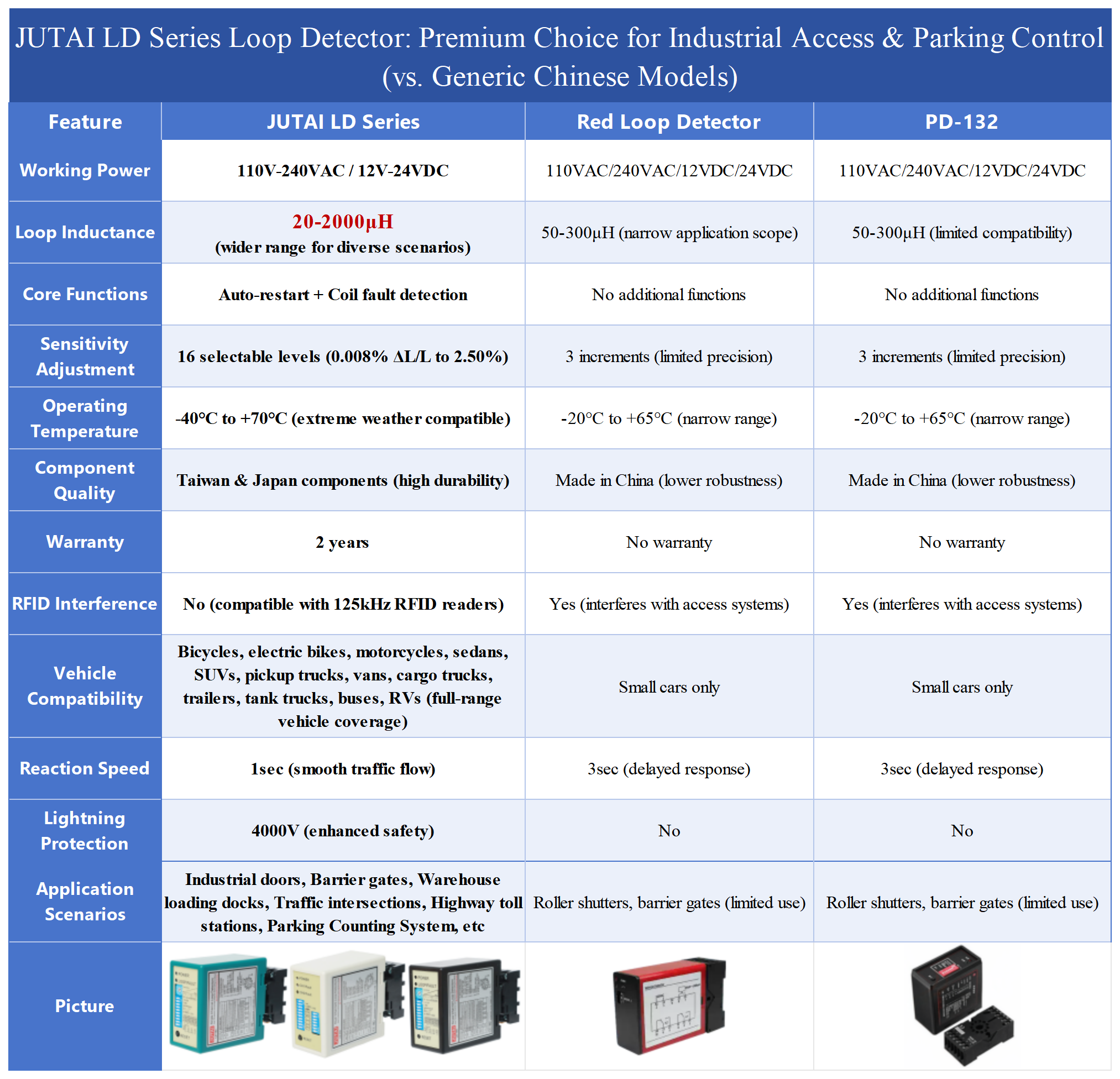
The JUTAI Dual Channel Loop Detector (Models LD200/LD202) is a professional-grade solution engineered for precise lane control and vehicle classification. It integrates dual independent channels, configurable direction modes, and adjustable sensitivity to meet the demands of traffic management, toll plazas, and smart road systems.
This detector supports both coordinated lane control (one-way passage, bidirectional separation) and accurate vehicle classification (distinguishing small cars, SUVs, trucks, and trailers), making it ideal for municipal traffic, commercial toll stations, and industrial lane management.
| Parameter | Specification |
|---|---|
| Product Name | Dual Channel Loop Detector |
| Models | LD200 (AC Power) / LD202 (DC Power) |
| Channels | 2 Independent (coordinated lane control or separate use) |
| Power Supply | 100-240V AC (LD200) / 12-24V DC (LD202) |
| Core Functions | Lane control, direction detection, vehicle classification |
| Direction Modes | 3 configurable modes (via S1 D3-D5 + S2 D1-D2) |
| Sensitivity | 8-level per channel (0.015%-0.8% DL/L); trailer sensitivity boost (DIP switch 1 ON) |
| Frequency Range | 20-100 kHz (4-step selectable via S1 D9-D10 + S2 D6-D7) |
| Response Time | 10-90 ms (on/off) |
| Relay Output | 2 Relays (1 per channel: COM + NO) |
| Status Indicators | Red Power LED + Green CH1/CH2 LEDs (continuous on = detection; slow blink = short circuit/insufficient loops; fast blink = open circuit/excess loops) |
| Reset Function | Manual reset button + configurable auto-reset (10-minute default, DIP switch 2 OFF) |
| Loop Inductance | 20-2000 µH per channel |
| Recommended Loop Turns | 3-4m (6 turns) / 4-6m (5 turns) / 6-10m (4 turns) / 10-20m (3 turns) / ≥20m (2 turns) |
| Operating Temperature | -40°C to +70°C |
| Humidity Tolerance | Up to 95% RH (non-condensing) |
| Warranty | 2-year manufacturer's warranty |


Sensitivity and frequency adjustment is facilitated through a 7-way dip switch and 10-way dip switch settings. Users can choose from 8 different sensitivity settings by configuring the dip switch positions according to the provided tables.
Dip switches 6, 7, and 8 govern CH1 sensitivity, ranging from 0.8 (least sensitive) to 0.015 (most sensitive). Dip switches 3, 4, and 5 control CH2 sensitivity, ranging from 0.8 (least sensitive) to 0.015 (most sensitive).

Switch 1 (S1): Channel 1 Loop Function Selection (10-way dip switch)

DIP 1 & DIP 2: Special Sensitivity Increase For Both Trailer (Both Channels)

D3, D4, D5 and Switch 2 D1, D2: Setting Special Functions (Mode1, 2, 3 Direction Detection. Mode 4, 5, 6 Normal mode, two loop detection are separated)

D6 & D7 & D8 and Switch 2 D3 & D4 & D5: Setting CH1 and CH2 Sensitivity Selection (Eight Levels Choices)

D9 & D10 and Switch2 D6, D7: Setting Frequency (20 K to 100 KHz)

Recommended installation overview of basic typical coil turns

When installing, please keep the product plug and socket in the vertical direction
The JUTAI LD200/202 double-channel vehicle loop detector series, equipped with direction recognition function, is ideal for numerous single-channel entry and exit scenarios. When integrated with the JUTAI One door controller (Model: AC-11), JUTAI gate barrier (Model: BR-110), and JUTAI long-range RFID reader (Model: PUHF-9), along with high-temperature resistance loop coils (Model: JTHT-11), it forms a seamless solution for single-channel entry/exit access control systems.


The JUTAI LD-200/202 Double Channel Loop Detector can also function as two independent single-channel loop detectors. This configuration is suitable for standard one-in and one-out parking lots, where there is one barrier and one long-range reader at both the entrance and exit.
In this setup, one loop coil is used to trigger the reader and read the card, while the other loop coil is dedicated to the barrier's anti-smashing function. By utilizing the LD-200/202 as two independent loop detectors, there is a potential cost-saving benefit from an economic standpoint. This setup reduces some of the hardware costs associated with using separate detectors for each function.
This functionality is achieved by enabling the Independent Working Mode feature of the LD-200/202, allowing it to operate effectively in this dual capacity.


|
 Gate Loop Detector for Barrier Industrial Doors Loop Short Open Circuit Indicator Reliable Performance
LD-200 Vehicle Direction Loop Detector with Dual Independent Channels for Parking Entrance and Exit Control
LD-100 Single Channel Vehicle Loop Detector with 16 Sensitivity Levels, 20-2000uH Range and Automatic Reset for Parking Barrier Gates
LD-200 Dual Channel Inductive Loop Detector for Parking Barrier Gate Vehicle Direction and Presence Detection
Dual Channel Inductive Vehicle Detector for Parking Entrance Exit Barrier Gate and Access Control Systems
Dual Loop Vehicle Detector with 6 Working Modes for Parking Barrier Gate Traffic and Access Control
LD-200 Parking Barrier Dual Loop Detector with 8 Level Sensitivity and Vehicle Direction Detection
Dual Channel Parking Vehicle Detector with 20-100kHz Adjustable Frequency and 8 Sensitivity Levels
LD-200 Dual Channel Vehicle Loop Detector with Direction Detection for Parking Barrier Gate Access Control
LD-200 Two Channel Parking Loop Detector with Direction Recognition Presence and Pulse Relay Outputs
Gate Loop Detector for Barrier Industrial Doors Loop Short Open Circuit Indicator Reliable Performance
LD-200 Vehicle Direction Loop Detector with Dual Independent Channels for Parking Entrance and Exit Control
LD-100 Single Channel Vehicle Loop Detector with 16 Sensitivity Levels, 20-2000uH Range and Automatic Reset for Parking Barrier Gates
LD-200 Dual Channel Inductive Loop Detector for Parking Barrier Gate Vehicle Direction and Presence Detection
Dual Channel Inductive Vehicle Detector for Parking Entrance Exit Barrier Gate and Access Control Systems
Dual Loop Vehicle Detector with 6 Working Modes for Parking Barrier Gate Traffic and Access Control
LD-200 Parking Barrier Dual Loop Detector with 8 Level Sensitivity and Vehicle Direction Detection
Dual Channel Parking Vehicle Detector with 20-100kHz Adjustable Frequency and 8 Sensitivity Levels
LD-200 Dual Channel Vehicle Loop Detector with Direction Detection for Parking Barrier Gate Access Control
LD-200 Two Channel Parking Loop Detector with Direction Recognition Presence and Pulse Relay Outputs

