Key Specifications
| Frequency Range | 2000Hz |
| Sine Force | 20kN / 2000kg / 4409lbf |
| Random Force | 20kN / 2000kg / 4409lbf |
| Shock Force | 98kN / 9800kg / 9918lbf |
| Channel | 2/4/8/16 |
| Maximum Acceleration | 100g |
| Maximum Displacement | 100mm (4") / 76mm (3") / 51mm (2") |
| Maximum Load | 300KG |
| Moving Parts Mass | 20KG |
| Armature Diameter | 335mm |
With over 10 million new energy vehicles in China as of June 2022,
representing 3.23% of total vehicles, the shift toward
electrification is accelerating globally. The power battery system
is the core component of electric vehicles, and its reliability
directly impacts vehicle safety. During operation, battery systems
endure constant vibration loads, making vibration resistance a
critical evaluation criterion.
Vibration Testing Methods
1.1 Sine Vibration
Sine vibration follows a periodic sine function, used for
fixed-frequency and sweep-frequency testing. Fixed-frequency tests
evaluate resonance resistance at specific frequencies, while
sweep-frequency tests (linear or logarithmic) help identify
structural resonance points across frequency ranges.
1.2 Random Vibration
Random vibration better simulates real-world conditions like road
surface irregularities. Described statistically in the frequency
domain, test parameters include frequency range (Hz), power
spectral density (PSD), total root mean square acceleration (Grms),
and test duration.
1.3 Mixed-mode Vibration
Combines sine and random vibration patterns (e.g., sine-on-random)
to simulate complex real-world vibration scenarios.
Battery System Vibration Standards Comparison
2.1 International Standards
Key standards include USABC 1996, SAE J2380 (referenced by UL2580),
UN 38.3 (transportation simulation), ISO 12405, and ECE R100-02
(European certification). These vary in test conditions, frequency
ranges, and sample requirements.
2.2 Domestic Standards
GB/T 31467.3-2015 (referencing ISO 12405) was revised in 2017 to
align with ECE R100-02's 3-hour sweep test. GB 38031, China's first
mandatory standard, specifies SOC ≥50% and vehicle-type-specific
loads based on real-world data.

Power Battery System Vibration Testing Process
3.1 Vibration Table
Electric vibration tables (5-3000Hz range) are most common, using
computer-controlled feedback systems to maintain precise test
conditions. Key parameters include maximum thrust, acceleration,
speed, displacement, and frequency range.

3.2 Test Fixtures
Fixtures must simulate vehicle mounting conditions (flat,
suspended, or press-fit) with appropriate stiffness (>test
frequency range), minimal mass, and limited lateral movement to
ensure accurate load transmission.
3.3 Sensor Placement
Control point sensors near mounting bolts provide feedback for
drive signal adjustment, while monitoring points track battery
parameters (voltage, temperature, insulation) during testing.
3.5 Case Study: GB38031 Compliance Test
A passenger vehicle battery system underwent pre-test sweeps
(57.06Hz natural frequency), random/fixed-frequency vibration in
X/Y/Z axes, and post-test sweeps (54.94Hz). Monitoring showed no
abnormalities, with normal post-test performance.

At Bonnen Battery, we rigorously test power batteries to national
standards, ensuring reliability against operational vibrations. Our
commitment delivers high-performance solutions for evolving
automotive needs.
Shaker Technical Specifications
| Parameter | Specification |
|---|
| Model | JQA-202-335 / JQA-203-335 |
| Frequency Range (Hz) | 5-3000 |
| Rated Sinusoidal Force (KN) | 20 |
| Shock Force (KN) | 40/60✱ |
| Max. Acceleration (m/s²) | 980 |
| Max. Speed (m/s) | 2 |
| Max. Displacement (mmp-p) | 51/76 |
| Max. Load (kg) | 300 |
| Vibration Isolation Frequency (Hz) | 2.5 |
| Moving Parts Weight (kg) | 23 |
| Armature Diameter (φmm) | 335 |
About Guangdong Jianqiao Testing Equipment Co., Ltd
For 20 years, we've specialized in R&D, production, and sales
of vibration test systems, environmental chambers, and battery
testing equipment. Our ISO9001-certified products meet
international standards (ISO, ASTM, DIN, EN, UL, etc.) and serve
top enterprises across aerospace, automotive, electronics, and
research sectors.
Senior R&D team with nationwide expertise
National marketing network coverage
11,289+ satisfied end users
![Contact us for vibration testing equipment inquiries]()
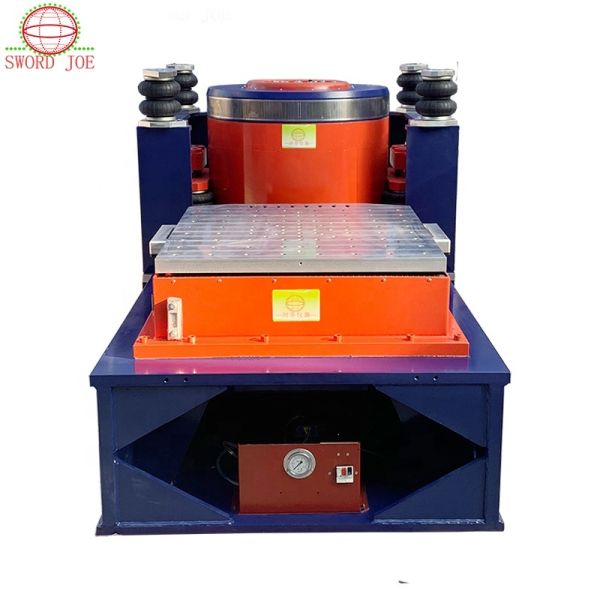
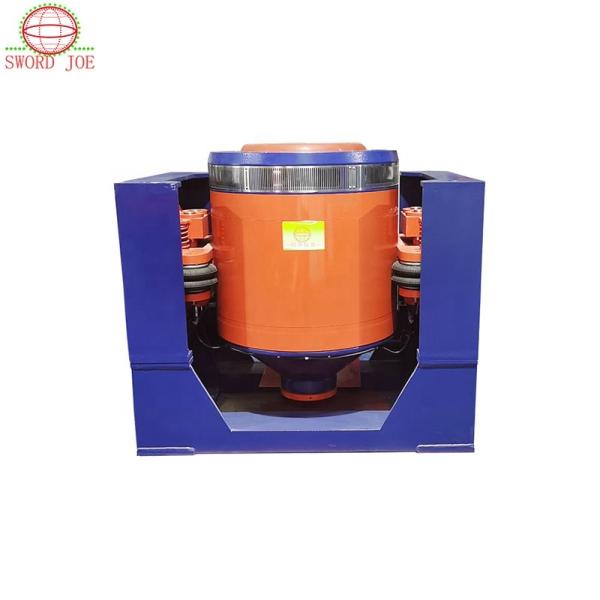
 Electro Dynamic Vibration Test Table AC 380V Water Cooled 51mm / 76mm Amplitude

