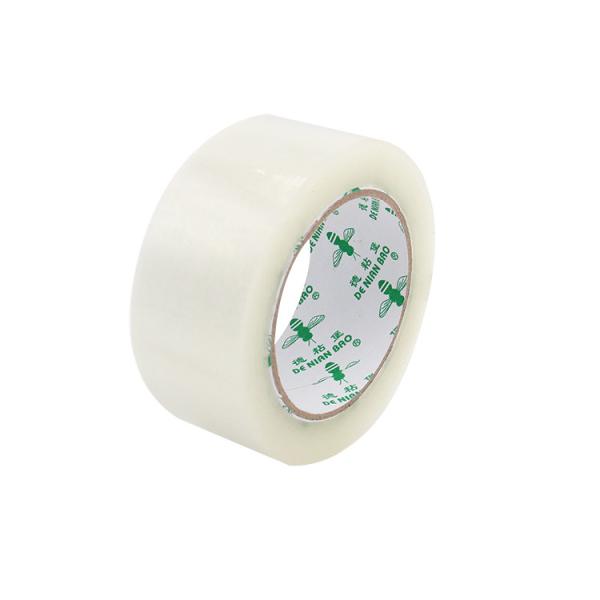
Self Adhesive Tape 48mm x 100m for Sealing Carton Factory wholesale
Description
1. Quick Summary (The "Elevator Pitch")
Self-adhesive tape, often referred to as pressure-sensitive tape
(PSA), adheres to surfaces with just light pressure. It requires no
water, solvents, or heat for activation, as its stickiness is
inherent and works instantly. The most familiar example is everyday
transparent tape.
2. Detailed Product Description (For a General Audience)
Self-adhesive tape is an essential tool used in homes, offices, and
industries across the globe. At its heart, it is a simple yet
clever product made up of three main components:
(1),Backing (or Carrier): This serves as the "body" of the tape. It
can be crafted from materials such as plastic (e.g., PVC, PP, PET),
paper, cloth, foam, or metal foil. The backing dictates the tape’s
strength, flexibility, and durability.
(2,)Adhesive: This is the sticky layer applied to the backing. It
is a specially formulated "viscoelastic" material that remains
permanently tacky. When you press the tape onto a surface, the
adhesive seeps into the surface’s tiny gaps, creating a strong
bond.
(3),Release Coating (or Liner): A non-stick layer (usually
silicone) applied to the back of the tape, it prevents the tape
from sticking to itself when rolled up. Not all tapes have this
layer; many rely on the non-stick properties of their backing
material.
Key Characteristics
(1),Instant Grab: It sticks to surfaces the moment they make
contact.
(2),No Activation Needed: Unlike glue, it only requires pressure to
work.
(3),Reusable (Some Types): Certain tapes, like painter’s tape or
some masking tapes, are designed for temporary holding and can be
removed cleanly without residue.
(4),Versatile: There are thousands of different types available,
each suited for specific tasks—from sealing boxes and mounting
mirrors to protecting surfaces during painting.
3. Technical / Commercial Description (For Buyers, Specifiers, and
Listings)
(1),Product Name: Pressure-Sensitive Adhesive (PSA) Tape
(2),Product Definition: A Pressure-Sensitive Adhesive Tape is a
composite material. It consists of a flexible backing coated with
an adhesive that stays permanently tacky at room temperature, and
forms a bond with a surface when light pressure is applied.
Key Components & Variations
Backing Material
(1),Films: Polypropylene (BOPP), Polyvinyl Chloride (PVC),
Polyester (PET), Polyethylene (PE). Used for packaging, electrical
insulation, and graphic applications.
(2),Papers: Crepe, Flatback, Kraft. Suitable for masking, painting,
and sealing.
(3),Foams: Polyurethane, Polyethylene, Acrylic. Applied in
mounting, sealing, and damping scenarios.
(4),Fabrics: Woven and non-woven cloth (e.g., duct tape). Used for
heavy-duty holding, bundling, and repairs.
(5),Metal Foils: Aluminum, Copper. Utilized for shielding and
sealing purposes.
Adhesive Type
(1),Rubber-Based (Solvent or Hot Melt): Offers excellent initial
tack and can adhere to various surfaces. It is cost-effective but
may yellow or degrade when exposed to UV light.
(2),Acrylic-Based (Water-Based or Solventless): Boasts superior
resistance to environmental factors (UV rays, heat, solvents). It
is clear and stable over time, but often takes longer to reach its
maximum strength.
(3),Silicone-Based: Performs exceptionally well in extreme
temperatures (both high and low). Used for masking during high-heat
processes and in the electronics industry.
(4),Specialty Adhesives: For example, gels that can be removed from
skin painlessly, and repositionable adhesives.
Performance Properties
(1),Adhesion (Peel Strength): The force required to peel the tape
off a standard surface.
(2),Cohesion (Shear Strength): The internal strength of the
adhesive, which resists flow under stress. It is crucial for the
tape’s holding power.
(3),Tack: The "stickiness" of the tape, or its ability to form an
instant bond with minimal pressure.
(4),Tensile Strength: The force needed to break the tape by pulling
its two ends in opposite directions.
(5),Elongation: The extent to which the tape can stretch before
breaking.
(6),Temperature & Chemical Resistance: The tape’s ability to
maintain its performance under specific environmental conditions.
Common Applications by Type
(1)Packaging: Sealing cartons (packing tape), making boxes.
(2),Industrial Assembly: Mounting, joining, masking during painting
or powder coating, damping vibrations.
(3),Electrical: Insulating and securing wires, providing shielding.
(4),Construction: Securing carpets (carpet tape), mounting
fixtures, sealing HVAC ducts (foil tape).
(5),Healthcare: Medical tapes for holding bandages and medical
devices in place.
Graphics & Signage: Mounting prints, applying vehicle wraps,
assembling displays.
4. Examples for Specific Use Cases
(1),For Sealing a Cardboard Box: "This clear BOPP packing tape
features a strong acrylic adhesive, creating a secure, permanent
seal to keep the contents of your box safe during shipping. It is
water-resistant and can be easily torn by hand."
(2),For Mounting a Photo Frame: "This double-sided foam tape has a
high-tack acrylic adhesive on both sides and a compressible foam
core. It forms a strong, gap-filling bond to hold your frame firmly
on the wall without damaging the paint."
(3),For Protecting Trim While Painting: "This blue painter’s tape
is made from a crepe paper backing with a specially formulated
adhesive. It delivers clean, sharp lines and can be removed without
leaving residue for up to 14 days—even when exposed to sunlight."
In summary, self-adhesive tape may seem simple, but its true value
lies in its great versatility. This versatility is achieved through
the precise engineering of its backing, adhesive, and coatings,
allowing it to meet countless different needs.
Quick Detail
1. Material: BOPP Film
2. Adhesive: Acrylic
3. Thickness: 50μ
4. Width: 55m
5. Length: 100yards
Specification
Adhesive Side
Single Sided
Adhesive Type
Pressure Sensitive, Water Activated, Hot Melt
Design Printing
Offer Printing
Advantage
1. Unwavering Secure Seal
2. Planet-Friendly Solution
3. Good Clarity
4. Effortless Handling and Application
5. Versatile Adhesion
6. Cost-Effective Performance