| Sign In | Join Free | My benadorassociates.com |
|
| Sign In | Join Free | My benadorassociates.com |
|
| Categories | Resistance Wire |
|---|---|
| Brand Name: | DLX |
| Model Number: | CuNi1 Wire |
| Certification: | Ce,Rohs |
| Place of Origin: | China,Jiangsu |
| MOQ: | 10kg |
| Payment Terms: | L/C,D/A,D/P,T/T,Western Union |
| Supply Ability: | 500 tons per month |
| Delivery Time: | 7-10 work days |
| Company Info. |
| Changzhou DLX Alloy Co., Ltd. |
| Verified Supplier |
| View Contact Details |
| Product List |

The global energy shift towards sustainable and clean energy solutions is accelerating, and hydrogen production plays a central role in this transformation. Electrolysis, a method of producing hydrogen by splitting water into oxygen and hydrogen, is considered one of the most promising technologies for clean hydrogen production. For electrolysis to be efficient, however, the right materials are essential. That’s where CuNi1 Copper-Nickel Wire comes into play. With its excellent resistance to corrosion, high efficiency, and long lifespan, CuNi1 alloy wire is an ideal choice for electrolysis applications, particularly in the production of hydrogen. DLX is proud to offer CuNi1 copper-nickel wire that ensures reliability and high performance for your electrochemical processes.
CuNi1 Copper-Nickel Wire is specifically engineered for use in hydrogen electrolysis, a key process in producing green hydrogen. The wire’s unique combination of copper and nickel provides a durable, corrosion-resistant solution that ensures both optimal performance and longevity in harsh electrochemical environments. Whether you're working with industrial-scale electrolyzers or laboratory-scale applications, CuNi1 wire is an excellent choice for enhancing the efficiency of your hydrogen production process.
At DLX, our CuNi1 copper-nickel wire is manufactured to meet the highest standards, offering both customization and consistency across applications. From enhancing the lifespan of your equipment to reducing energy consumption, our CuNi1 wire is the trusted material you need for your electrolysis projects.
Properties Material | Resistivity 200c μΩ.m | Max working temperature (℃) | Tensile strength (Mpa) | Melting point (℃) | Density (g/cm3) | TCR *10-6/℃ (20-600℃) | EMF vs Cu (μV/℃) (0-100℃) |
|---|---|---|---|---|---|---|---|
CuNi1 | 0.03 | 200 | 210 | 1085 | 8.9 | <100 | -8 |
CuNi2 | 0.05 | 200 | 220 | 1090 | 8.9 | <120 | -12 |
CuNi6 | 0.1 | 220 | 250 | 1095 | 8.9 | <60 | -18 |
CuNi8 | 0.12 | 250 | 270 | 1097 | 8.9 | <57 | -22 |
CuNi10 | 0.15 | 250 | 290 | 1100 | 8.9 | <50 | -25 |
CuNi14 | 0.2 | 300 | 310 | 1115 | 8.9 | <30 | -28 |
CuNi19 | 0.25 | 300 | 340 | 1135 | 8.9 | <25 | -32 |
CuNi23 | 0.3 | 300 | 350 | 1150 | 8.9 | <16 | -34 |
CuNi30 | 0.35 | 350 | 400 | 1170 | 8.9 | <10 | -37 |
CuNi34 | 0.4 | 350 | 400 | 1180 | 8.9 | 0 | -39 |
CuNi44 | 0.5 | 400 | 420 | 1200 | 8.9 | <-6 | -43 |
Size Range | |
|---|---|
Wire | 0.08-7.5mm |
Ribbon | (0.05-0.35)*(0.5-6.0)mm |
Strip | (0.50-2.5)*(5-180)mm |
Rod | 8-50mm |


The demand for hydrogen, particularly green hydrogen, is on the rise. As countries strive to meet climate goals and reduce greenhouse gas emissions, hydrogen is emerging as a clean alternative to fossil fuels. Electrolysis plays a central role in this shift, and the materials used in electrolysis systems are becoming increasingly critical for ensuring efficient and sustainable hydrogen production.
The growing adoption of hydrogen fuel cells in industries like transportation, power generation, and heavy manufacturing is further driving the demand for high-performance materials like CuNi1 copper-nickel wire. This wire’s ability to withstand harsh environments, maintain conductivity, and ensure long-term performance positions it as a leading choice for the hydrogen industry.
As electrolyzers continue to evolve and scale, materials like CuNi1 copper-nickel wire will be instrumental in advancing the hydrogen economy. It offers a cost-effective, sustainable solution that meets the increasing need for high-efficiency materials in electrolysis systems.
CuNi1 copper-nickel wire is primarily used in:

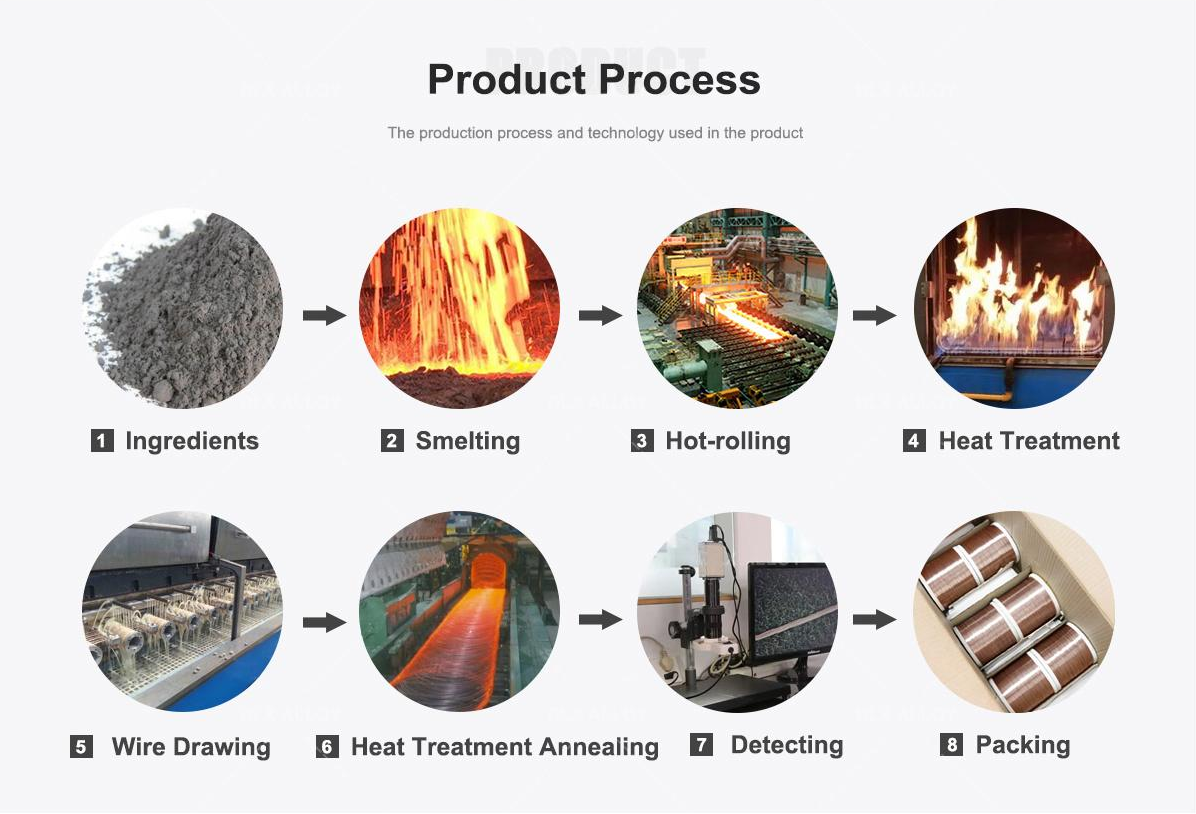
DLX is a trusted leader in the manufacturing of high-quality materials for electrochemical applications, with a strong focus on research and development to meet the evolving needs of the hydrogen sector. We offer:


|
 ASTM B344 NiCr 80/20 Nichrome Resistance Wire 1200°C Maximum Operating Temperature 1400°C Melting Point For Industrial Heating Elements
0Cr15Al5 FeCrAl Alloy Wire for Electrolysis Hydrogen Production
High Performance 0Cr15Al5 Alloy Wire for Hydrogen Generation
0Cr15Al5 FeCrAl Wire for Efficient Electrolysis in Hydrogen Production
1Cr13Al4 FeCrAl Resistance Wire for Industrial Hydrogen Electrolysis
Reliable 1Cr13Al4 Alloy Wire for Hydrogen Generation via Electrolysis
1Cr13Al4 FeCrAl Wire for Electrolysis Hydrogen Production Applications
0Cr21Al4 FeCrAl Resistance Wire for Efficient Hydrogen Production
0Cr21Al4 Alloy Wire for High Temperature Electrolysis Hydrogen Generation
0Cr21Al4 FeCrAl Wire for Hydrogen Production Systems
ASTM B344 NiCr 80/20 Nichrome Resistance Wire 1200°C Maximum Operating Temperature 1400°C Melting Point For Industrial Heating Elements
0Cr15Al5 FeCrAl Alloy Wire for Electrolysis Hydrogen Production
High Performance 0Cr15Al5 Alloy Wire for Hydrogen Generation
0Cr15Al5 FeCrAl Wire for Efficient Electrolysis in Hydrogen Production
1Cr13Al4 FeCrAl Resistance Wire for Industrial Hydrogen Electrolysis
Reliable 1Cr13Al4 Alloy Wire for Hydrogen Generation via Electrolysis
1Cr13Al4 FeCrAl Wire for Electrolysis Hydrogen Production Applications
0Cr21Al4 FeCrAl Resistance Wire for Efficient Hydrogen Production
0Cr21Al4 Alloy Wire for High Temperature Electrolysis Hydrogen Generation
0Cr21Al4 FeCrAl Wire for Hydrogen Production Systems

