Product Description:
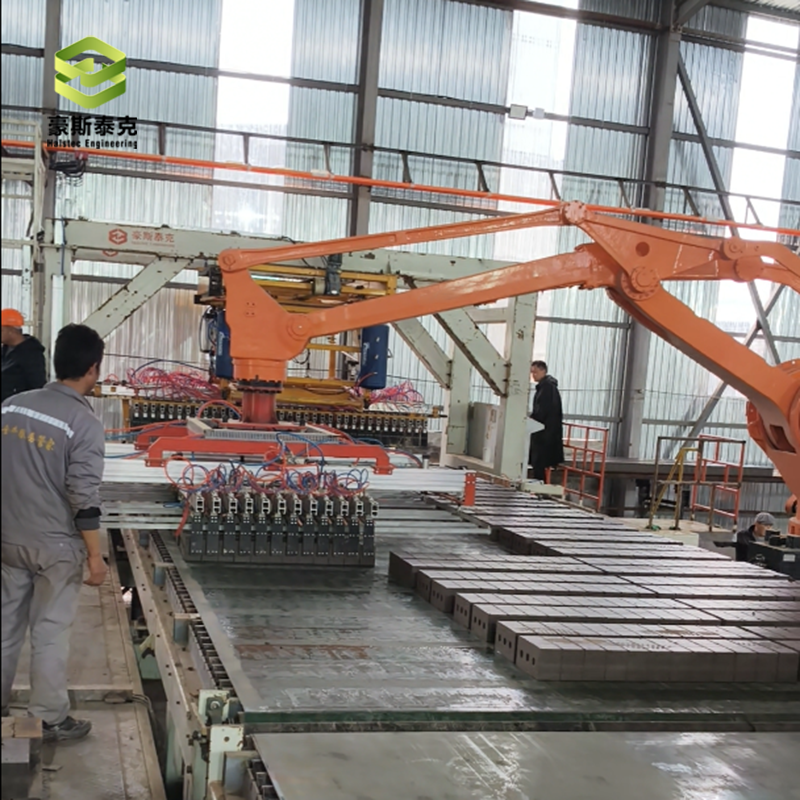
The robot stacking machine is an automated palletizing device based
on industrial robot technology. It typically employs a 4-axis or
6-axis articulated robot structure and is equipped with a dedicated
brick gripping system. The equipment is linked to upstream
extruders, strip cutters, and brick cutters via a PLC control
system, automatically completing the entire process of grouping and
organizing brick blanks, gripping and picking them up, turning them
90° (for staggered stacking), and layering them onto kiln cars.
This equipment is suitable for brick stacking operations in various
kiln types, including tunnel kilns and mobile kilns. It can handle
standard bricks, perforated bricks, hollow bricks, and blocks,
making it a mainstream choice for the automation upgrade of
sintered brick and tile production lines.

Structural Composition:
-Robot Body: A multi-jointed robotic arm providing load capacity
and degrees of freedom of movement. Four-axis robots are commonly
used in brick factories to meet palletizing requirements.
-Clamping Device (Clamping Plate): Utilizing pneumatic or hydraulic
drive, equipped with pressure sensors for adaptive force adjustment
to prevent damage to wet bricks. Various brick types can be
accommodated by changing different clamping plates.
-Grouping and Conveying System: Separates, sorts, and groups the
brick blanks output from the cutting machine according to stacking
requirements, preparing them for robot gripping.
-Control System: A PLC-based and servo-driven control system with
built-in programs for various brick type stacking, real-time
monitoring of output and production status, and one-click switching
of brick types.
-Moving Mechanism: Some large robots are equipped with a track-type
walking axis, expanding the operating range and serving multiple
kiln car positions.
Technical Parameters:
| Product Name | Automatic Robot Stacking Machine |
| Power | 17kw |
| Warranty | 1 Year |
| Gripper | Customized |
| Highlight | Auto, Brick Factory, Brick Machine, Brick Production |
| Certification | CE/ISO |
| Capacity | 30000 Bricks Per Hour |
| Function | To Stack Bricks |
Applications:
The robot coding machine used in brick factories is the core
automation equipment in modern brick and tile production lines. It
utilizes the flexibility and intelligent control technology of
multi joint industrial robots to replace manual labor in grabbing,
transporting, turning, and stacking brick blanks. Compared to
traditional gantry style brick laying machines, robot brick laying
machines have the advantages of smaller footprint, more flexible
movements, and wider applicability to brick types. They are key
equipment for brick and tile enterprises to achieve "machine
replacement" and improve quality and efficiency.
Workflow:
The standard operating procedure for a robot stacking machine is as
follows:
-Grouping and Seaming: Brick blanks cut by the cutting machine are
pushed onto the separating plate. The separating mechanism creates
uniform gaps between the brick blanks.
-Positioning and Grasping: The robot moves its clamping plate
directly above the brick blanks. The clamping plates close, stably
holding the brick blanks.
-Lifting and Transporting: The robot lifts the held brick blanks to
a safe height and moves them along a planned path to the kiln car
station.
-Rotation and Steering: During transport, the robot's wrist
performs a 90° rotation, causing the brick blanks to be stacked in
a cross pattern on the kiln car, ensuring stacking stability.
-Layered Stacking: The robot descends to the predetermined stacking
height, the clamps release, and one layer of brick blanks is
stacked. The above actions are repeated layer by layer until the
kiln car is full.

Advantage:
-High precision and high stability: Servo drive and precision
reducer ensure repeatability ≤1mm. The height of each layer of
bricks is precisely controlled by an encoder, resulting in high
stacking neatness and preventing brick tipping.
-Flexible production changeover and strong adaptability: Built-in
standard programs adaptable to more than ten brick types. Product
changeover can be quickly completed by changing the clamping plate
and switching programs, without complex mechanical adjustments.
-Reduced operating costs: One robot can replace 6-8 brick stacking
workers, significantly reducing labor and management costs. The new
drive mechanism design reduces spare parts costs by approximately
90% compared to traditional models.
-Improved product quality: Neat and standardized stacking promotes
uniform ventilation during drying and firing, reducing scrap rates.
Gentle and stable clamping actions effectively reduce damage to wet
bricks.
-Easy operation and maintenance: A full Chinese touchscreen
interface allows for dynamic parameter settings, and layer/stack
connections are intuitive and easy to understand. The system can
record production data for multiple shifts, facilitating production
management.

 100000 Hollow Brick Production Plant 310T Clay Brick Plant Fully Automated

